The architecture-as-code evolution: moving beyond dead diagrams to a living platform model
Relying on dead diagrams to mitigate critical risks is a dangerous approach. Architecture must be treated with the exact same rigor as the systems it describes. Enter LikeC4 and the true 'Architecture-as-Code' paradigm.
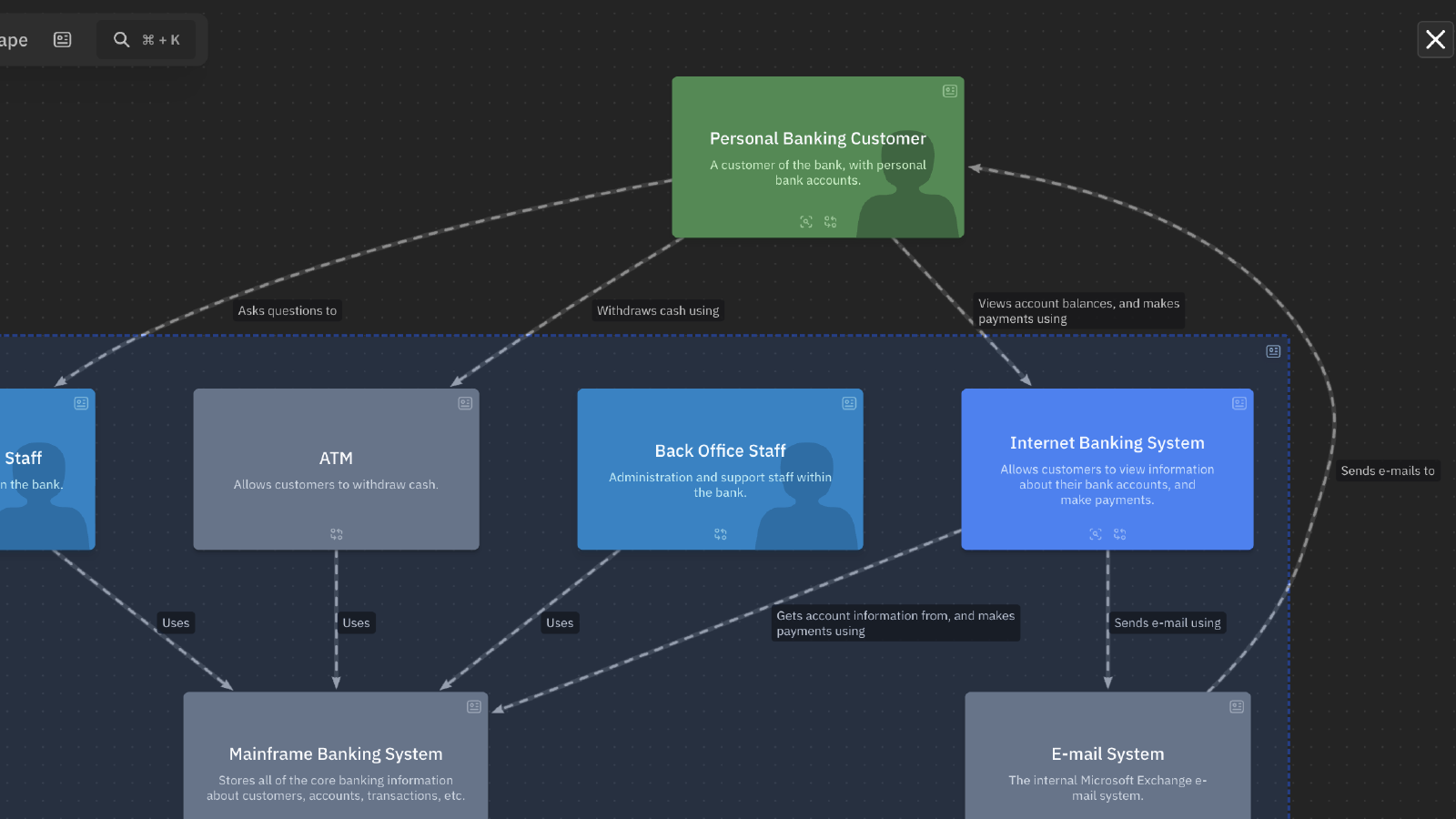
In deeply regulated industries, a strange paradox exists: an auditor can be handed a beautifully polished PDF diagram that is completely disconnected from the actual production environment, and they will happily check their box. But relying on “dead documentation” to mitigate critical risks and manage legacy tech obsolescence is a dangerous approach.
Tackling technological obsolescence is a long-term challenge that requires vision and patience. Legacy technologies continue to be the operational pillars of large enterprises and institutions today. Modernizing these mission-critical environments without disruption cannot be accomplished if the architecture lives in disconnected silos. When one file dictates infrastructure, another maps data flows, and a spreadsheet lists inventory, there is no source of truth. It becomes a collection of fiction.
Our philosophy is that architecture must be treated with the exact same rigor as the systems it describes.
Why visual drag-and-drop fails the scale test
For years, the standard response to documenting systems was to open tools like Draw.io, Visio, or Miro. While great for a quick brainstorming session, they fall apart the moment a platform grows.
If architecture is the blueprint of business risk, information must be treated as code with strict versioning. Graphic tools eliminate the possibility of a clean Git history, Pull Requests, or automated tracking.
When a quick, isolated diagram is needed for a README file or to align a team during an interactive meeting, Mermaid.js is king. It’s lightweight and handles quick text-to-diagram generation beautifully. But it simply doesn’t scale when a single, authoritative model is required for an entire enterprise platform.
The reality of the hybrid, multicloud ecosystem
Every major cloud provider offers excellent native diagramming and monitoring tools. If an organization lives 100% within a single cloud ecosystem, those tools work remarkably well. However, the operational reality for most enterprise environments is far messier. The true landscape is a complex mix of multiple cloud providers, various managed services, and legacy on-premises infrastructure.
Because no single cloud provider’s tool can natively or objectively map a competitor’s environment or a local bare-metal data center, a neutral, cross-platform modeling tool becomes essential to bridge the gaps.
The search for the ultimate model
Finding a tool that balances data richness with developer-friendly workflows is a long journey. Many traditional Configuration Management Databases (CMDBs) and enterprise modeling tools promise a lot but come with massive overhead or rigid constraints.
- The C4 Model & Structurizr: An excellent framework for software systems, but its rigid hierarchy often forces teams to awkwardly shoehorn infrastructure, datasets, and repositories into strict software-centric buckets.
- ArchiMate: For a long time, this was a solid middle ground. The core philosophy behind ArchiMate, especially its structural layering (Business, Application, Technology), is brilliant for mapping complex platform ecosystems. One of the standout features of ArchiMate is its extensibility; tools like jArchi allow custom JavaScript scripting to manipulate models, and the ability to query architectural data using SQL provides incredibly powerful analysis capabilities. The fatal flaw, however, is that the underlying files are often a mess of machine-generated XML. While the distinct advantage is that these file changes can be powerfully tracked in Git, it is practically impossible for a human developer to cleanly write, review, or diff that XML code by hand in a standard text editor.
LikeC4: A true living source of truth
The holy grail of architecture modeling is a tool that allows engineering teams to write clean, human-readable code, maintain operational metadata (like container images, server IPs, and repositories), and automatically compile it into highly interactive views for stakeholders.
Recently, LikeC4 has completely shifted the paradigm. (For an excellent, comprehensive example of what this looks like in practice, explore their BigBank Showcase).
What makes it highly compelling is that it breaks away from rigid structures while maintaining the discipline of models-as-code. Platform primitives can be custom-defined (like a native dataset or on-prem-node) and attached to robust metadata blocks that support native arrays.
Because the entire model is written in a declarative syntax, it is remarkably straightforward to develop automation scripts that query actual infrastructure. For example, we generated simple automations that read our Terraform state files and other local configuration sources, connect via API/CLI directly to various cloud providers, and automatically update the central architecture model on every Pull Request (PR). This ensures that the generated model consistently reflects real, true operational facts rather than architectural idealizations.
AI and CI/CD integration
Furthermore, this operates beautifully at the intersection of automation and artificial intelligence. By integrating LikeC4 directly into the CI/CD pipeline, every commit automatically validates the architecture and regenerates the interactive diagrams. There is no more forgetting to update the wiki.
Because LikeC4 natively exposes its model via the Model Context Protocol (MCP), AI agents can be plugged directly into the architecture. An LLM can be asked, “What systems are impacted if this database goes down?” and it will answer based on the strictly validated code in the repository.
Instead of generating a static image that goes out of date the next time a container image is updated or a VM is migrated, LikeC4 allows the platform architecture to be treated as an evolving, version-controlled repository. It bridges the gap between technical reality and stakeholder visualization, making it a perfect fit for complex, hybrid environments where managing technological obsolescence, maintaining security, and running a rigorously audited platform are non-negotiable.
If your organization is struggling to map its legacy infrastructure or transition to a true Architecture-as-Code model, reach out to us at JAAB.tech to explore how we can help.